Checked
About Ottawa, Ontario: a newcomer's and visitor's guide to Canada's capital
Ottawa, Ontario, Canada
What to know about Ottawa, Ontario, Canada's capital: where it is, 2021 Census population and latest estimate, former towns and neighbourhoods, OC Transpo and the O-Train, jobs, climate, languages, hospitals, universities and landmarks.
Key information
Ottawa is Canada's capital, on the Ottawa River at Ontario's border with Quebec, and had 1,017,449 people in the 2021 Census (Statistics Canada estimated 1,188,114 on July 1, 2025). It is a bilingual government and technology city of long cold winters and warm summers, known for Parliament Hill and the Rideau Canal.
On this page
Ottawa at a glance
| Fact | Ottawa |
|---|---|
| Province and country | Ontario, Canada (capital of Canada) |
| Population, 2021 Census | 1,017,449 (4th largest municipality in Canada) |
| Population, 2016 Census | 934,243 (growth of 8.9% to 2021) |
| Statistics Canada estimate, July 1, 2025 | 1,188,114 |
| Ottawa-Gatineau metro area, 2021 Census | 1,488,307 (about 1.70 million estimated in 2025) |
| Land area | 2,788.2 km² (364.9 people per km² in 2021) |
| Incorporated as a city | 1855, when Bytown became Ottawa |
| Named capital | Announced December 31, 1857 |
| Current city formed | January 1, 2001 (amalgamation) |
Ottawa is the capital of Canada and the fourth-largest municipality in the country by 2021 Census population. Today's city was formed on January 1, 2001, when old Ottawa merged with 11 nearby municipalities and the regional government.
Sources: Statistics Canada: Population and dwelling counts, census subdivisions (table 98-10-0002-01) · Statistics Canada: Population estimates, July 1, census subdivisions (table 17-10-0155-01) · Statistics Canada: Population and dwelling counts, census metropolitan areas (table 98-10-0005-01) · Statistics Canada: Population estimates, July 1, census metropolitan areas (table 17-10-0148-01) · The Canadian Encyclopedia: Ottawa
Where is Ottawa?
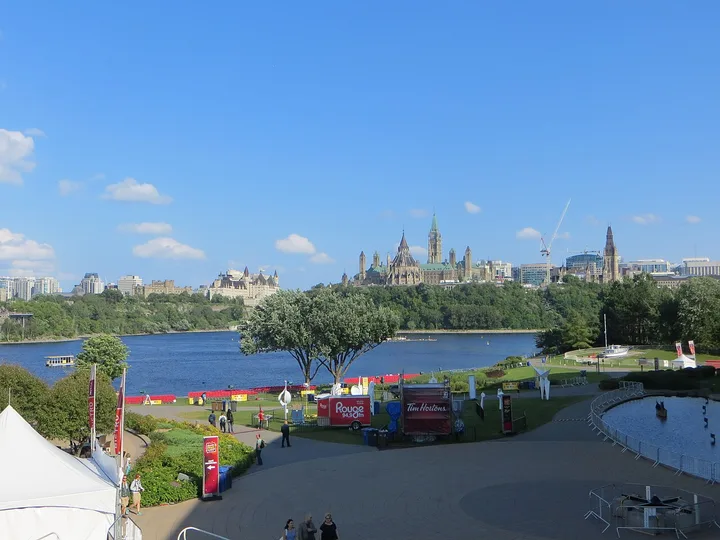
Ottawa sits on the south bank of the Ottawa River, on Ontario's eastern border with Quebec, about 200 km west of Montréal. The Rideau and Gatineau rivers join the Ottawa River here, and the Rideau Canal runs through the middle of the city.
Gatineau, Quebec is directly across the river. The two cities form one metropolitan area that is about two-thirds in Ontario and one-third in Quebec, so many people live in one province and work in the other.
The city is unusually large. Its 2,788 km² take in the downtown core, suburbs and a big rural area with farms and villages. A federal greenbelt of farms and forest wraps around the older built-up area.
Sources: The Canadian Encyclopedia: Ottawa · Statistics Canada: Population and dwelling counts, census subdivisions (table 98-10-0002-01)
How many people live in Ottawa?
- 2016 Census934,243 people
- 2021 Census1,017,449 people
- 2025 estimate1,188,114 people
The 2021 Census counted 1,017,449 people in the City of Ottawa, up 8.9% from 934,243 in 2016. Statistics Canada's population estimate for July 1, 2025 is 1,188,114. Estimates are adjusted for people the census missed, so they are not directly comparable with census counts.
The wider Ottawa-Gatineau metropolitan area counted 1,488,307 people in 2021, with 1,135,014 on the Ontario side. Statistics Canada estimated the metro area at 1,700,014 on July 1, 2025.
Sources: Statistics Canada: Population and dwelling counts, census subdivisions (table 98-10-0002-01) · Statistics Canada: Population estimates, July 1, census subdivisions (table 17-10-0155-01) · Statistics Canada: Population and dwelling counts, census metropolitan areas (table 98-10-0005-01) · Statistics Canada: Population estimates, July 1, census metropolitan areas (table 17-10-0148-01)
Main areas and former towns
Many Ottawa addresses still use the names of the places that merged in 2001: the cities of Ottawa, Vanier, Nepean, Kanata, Gloucester and Cumberland, the townships of Rideau, West Carleton, Goulbourn and Osgoode, and the village of Rockcliffe Park.
The oldest part of town is Lower Town, east of the canal, which includes the ByWard Market and Sussex Drive, sometimes called the Mile of History. Upper Town, west of the canal, grew up around government offices and shops after Ottawa became the capital. Suburbs such as Kanata grew from the 1970s, many of them outside the greenbelt and close to the technology industry.
- Downtown: Parliament Hill, federal offices, the Rideau Centre and the canal.
- Lower Town and the ByWard Market: restaurants, the market and Sussex Drive.
- West end: the Nepean, Kanata and Goulbourn suburbs, where much of the technology industry grew.
- East end: the former cities of Gloucester, Cumberland and Vanier.
- Rural Ottawa: West Carleton, Osgoode and Rideau, with villages and farmland.
Sources: The Canadian Encyclopedia: Ottawa
How do people get around Ottawa?
OC Transpo, the city-run transit agency, runs buses, Para Transpo and the O-Train light rail. Line 1 crosses downtown east to west. The expanded north-south Line 2 and the new Line 4 began service in stages on January 6, 2025. Line 2 runs south to Limebank and Line 4 links to the Ottawa airport. The Line 1 east extension to Trim was still in testing on November 18, 2026, and the west extension and new Line 3 are under construction.
Ottawa Macdonald-Cartier International Airport opened in 1960 and serves the busy Montréal, Toronto and Ottawa air corridor. The city also has more than 600 km of bike paths and trails, and in winter some people skate to work along the Rideau Canal.
Sources: OC Transpo: O-Train expansion · CBC News: Trillium Line to reopen in stages starting Monday, Jan. 6 · The Canadian Encyclopedia: Ottawa
What are the main jobs and employers?
The federal government is the city's biggest employer and largest landowner. More Ottawa residents work in public administration than in any other field, followed by health care and social assistance, professional, scientific and technical services, and retail.
Ottawa also has a large technology sector. It began in 1961 with Computing Devices and the labs of Bell Northern Research (later Nortel), and companies such as Corel and JDS Uniphase later earned the region the nickname Silicon Valley North. Many tech firms are in the western suburbs such as Kanata.
Sources: The Canadian Encyclopedia: Ottawa
What is Ottawa's weather like?
| Month | Daily average | Average high | Average low | Precipitation |
|---|---|---|---|---|
| January | -9.6 °C | -5.2 °C | -14.0 °C | 65.2 mm |
| April | 6.2 °C | 11.2 °C | 1.1 °C | 81.3 mm |
| July | 21.3 °C | 26.7 °C | 15.8 °C | 92.3 mm |
| October | 8.8 °C | 13.3 °C | 4.1 °C | 90.2 mm |
| Whole year | 6.8 °C | 11.7 °C | 1.9 °C | 938.1 mm (184.5 cm of snow) |
Ottawa has four strong seasons. January averages -9.6 °C and July averages 21.3 °C. The city gets about 184.5 cm of snow a year, and summer has about 13 days a year above 30 °C.
The coldest temperature on record at the Ottawa station is -38.9 °C on December 29, 1933. The hottest is 37.8 °C, reached on July 4, 1913 and August 1, 1917.
Sources: Environment and Climate Change Canada: 1991 to 2020 Climate Normals, Ottawa (City)
What languages are spoken in Ottawa?
Ottawa is one of Canada's most bilingual big cities. In the 2021 Census, 36.4% of residents (367,035 people) said they can hold a conversation in both English and French. English was the only mother tongue of 58.2% of residents, French of 12.5%, and a language other than English or French of 23.1%.
City services, hospitals and many employers work in both official languages, and the University of Ottawa is the world's largest bilingual (English and French) university.
Sources: Statistics Canada: Mother tongue and knowledge of official languages, 2021 Census (table 98-10-0170-01) · The Canadian Encyclopedia: University of Ottawa
Main hospitals, universities and colleges
- The Ottawa Hospital: the main adult teaching and research hospital for Eastern Ontario, working in English and French with the University of Ottawa.
- CHEO: the children's hospital and pediatric research centre.
- University of Ottawa: founded as the College of Bytown in 1848, steps from Parliament.
- Carleton University: founded in 1942, south of the downtown core.
- Saint Paul University: affiliated with the University of Ottawa.
- Algonquin College and La Cité: the English and French public colleges.
Sources: The Ottawa Hospital: About us · CHEO: About CHEO · The Canadian Encyclopedia: University of Ottawa · The Canadian Encyclopedia: Ottawa
Landmarks and what Ottawa is known for
Ottawa is best known for Parliament Hill, the Rideau Canal and its winter Skateway, spring tulips and national museums. Parliament Hill is the centre of Canada Day celebrations on July 1.
- Parliament Hill: the Centre Block and Peace Tower have been closed since 2018 for a major renovation expected to finish in 2031. The Library of Parliament is the only part of the original 1866 Centre Block to survive the 1916 fire.
- Rideau Canal: a UNESCO World Heritage Site since 2007. In winter, the National Capital Commission turns 7.8 km of it into the free Rideau Canal Skateway.
- ByWard Market: one of Canada's oldest urban markets.
- Rideau Hall: home of the Governor General since 1867, with grounds open to the public.
- National Gallery of Canada, Canadian War Museum and the National Arts Centre.
- Central Experimental Farm: a working federal research farm in the middle of the city since 1886.
- Diefenbunker: Canada's Cold War Museum, a four-storey underground bunker in Carp.
Sources: The Canadian Encyclopedia: Parliament Buildings · Parks Canada: Rideau Canal National Historic Site, history · National Capital Commission: Rideau Canal Skateway · The Canadian Encyclopedia: Ottawa · The Canadian Encyclopedia: Central Experimental Farm · The Canadian Encyclopedia: Diefenbunker
Questions people ask about Ottawa
What is the population of Ottawa?
The 2021 Census counted 1,017,449 people in the City of Ottawa, and Statistics Canada estimated 1,188,114 on July 1, 2025.
Source: Statistics Canada: Population estimates, July 1, census subdivisions (table 17-10-0155-01)
What province is Ottawa in?
Ottawa is in Ontario, on the Ottawa River at the Quebec border. Gatineau, Quebec is across the river.
What is Ottawa known for?
Ottawa is known as Canada's capital, for Parliament Hill, the Rideau Canal and its winter Skateway, the spring Tulip Festival and national museums.
Is Ottawa a bilingual city?
Yes, in practice. In 2021, 36.4% of residents could speak both English and French, and 12.5% had French as their only mother tongue.
How cold does Ottawa get in winter?
January averages -9.6 °C, with average lows of -14.0 °C. The record low is -38.9 °C, set on December 29, 1933.
Source: Environment and Climate Change Canada: 1991 to 2020 Climate Normals, Ottawa (City)
How much snow does Ottawa get?
About 184.5 cm of snow a year on average (1991 to 2020 normals), most of it from December to March.
Source: Environment and Climate Change Canada: 1991 to 2020 Climate Normals, Ottawa (City)
Who is the biggest employer in Ottawa?
The federal government. Public administration employs more Ottawa residents than any other field.
Does Ottawa have a train to the airport?
Yes. O-Train Line 4 links the airport to Line 2. Both began service in stages on January 6, 2025.
Source: CBC News: Trillium Line to reopen in stages starting Monday, Jan. 6
How big is the city of Ottawa?
The city covers 2,788.2 km², including a large rural area, since 11 municipalities and the regional government merged in 2001.
Source: Statistics Canada: Population and dwelling counts, census subdivisions (table 98-10-0002-01)
How long is the Rideau Canal Skateway?
7.8 km. It usually opens from January to early March, weather permitting, and is free and open 24 hours a day when open.