Checked
History of Ottawa, Ontario: from Algonquin territory and Bytown to Canada's capital
Ottawa, Ontario, Canada
A short history of Ottawa, Ontario: Algonquin Anishinaabe territory, the fur trade, Bytown and the Rideau Canal, becoming the capital in 1857, the 1900 and 1916 fires, amalgamation in 2001 and a full timeline.
Key information
Ottawa began in 1826 as a construction camp for the Rideau Canal, grew into the lumber town of Bytown, and was renamed Ottawa when it became a city in 1855. Queen Victoria's choice made it the capital in 1857, on land that is the traditional, unceded territory of the Algonquin Anishinaabe.
On this page
Algonquin territory and the Great River
Ottawa stands on the traditional territory of the Algonquin people, whose lands centre on the Ottawa River and its tributaries. Many Ottawa institutions, such as the Canada Council for the Arts, describe the land as the unceded, unsurrendered territory of the Anishinaabe Algonquin Nation, whose presence reaches back to time immemorial. Unceded means the land was never given up through a treaty.
Until about 8,000 BCE, the valley lay under the Champlain Sea. The Algonquin called the river Kichi Sibi, the Great River. It carried trade between Indigenous peoples as far as Labrador and Lake Superior. After Europeans arrived, epidemics and wars with the Haudenosaunee weakened the Algonquin, who lost control of the river by about 1650.
In 2016, the Algonquins of Ontario signed an agreement-in-principle with Ontario and Canada on a land claim covering 36,000 km² of the Ottawa River watershed in Ontario. The claim is disputed: only one of the 10 communities in the organization, the Algonquins of Pikwakanagan, is a federally recognized First Nation, Pikwakanagan voted against ratifying the agreement, and Algonquin First Nations in Quebec and some Haudenosaunee First Nations have rejected it.
Sources: Canada Council for the Arts: Land acknowledgement · The Canadian Encyclopedia: Algonquin · The Canadian Encyclopedia: Ottawa
Where does the name Ottawa come from?
The name is thought to come from the Odawa (Ottawa), an Algonquian-speaking First Nation, probably from a word meaning "to trade". The Odawa homeland was further west, along Lake Huron, but the river and later the city took the name. Before 1855, the town was called Bytown after John By.
Sources: The Canadian Encyclopedia: Ottawa
Explorers, fur traders and the first farms
Étienne Brûlé was the first European to travel the Ottawa River, in 1608. Samuel de Champlain followed in 1613 and took part in an Algonquin ceremony at the Chaudière Falls. From the 1600s to the 1800s, the river was the main route of the Montréal fur trade.
In 1800, Philemon Wright of New England founded a farming settlement at present-day Gatineau (then Hull) and started the squared-timber trade in 1806. On the Ontario side, Ira Honeywell settled in Nepean in the winter of 1809 to 1810, and families of British soldiers settled Richmond in 1818.
Sources: The Canadian Encyclopedia: Ottawa
Bytown and the Rideau Canal (1826 to 1854)
After the War of 1812, Britain wanted a safe military supply route from Montréal to Kingston away from the American border. Lieutenant-Colonel John By of the Royal Engineers arrived in 1826 and set up his base near the mouth of the Rideau River. Contractors, labourers and merchants followed, and by 1827 the town of Bytown had grown up beside the canal works.
The 202 km canal, with 47 locks, opened in the summer of 1832. Most labourers were French Canadians and Irish immigrants, and many died of malaria. Bytown then became a supply centre for the timber trade and, by the 1850s, a sawmilling town powered by the Chaudière and Rideau falls.
Sources: Parks Canada: Rideau Canal National Historic Site, history · The Canadian Encyclopedia: Ottawa
Becoming the capital (1855 to 1867)
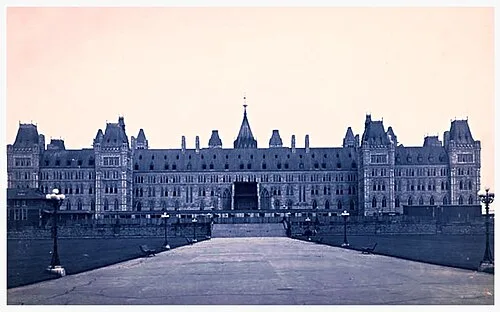
Bytown became the City of Ottawa in 1855. Rail links made it a serious candidate for permanent capital of the Province of Canada, but rivalries between cities made the choice politically dangerous. The decision went to Queen Victoria, and her choice of Ottawa was announced on December 31, 1857.
Construction of the Parliament Buildings started in 1859, and they officially opened on June 6, 1866. In 1867 Ottawa became the capital of the new Dominion of Canada. Its population nearly tripled from 7,760 in 1851 to 21,545 in 1871.
Sources: The Canadian Encyclopedia: Ottawa · The Canadian Encyclopedia: Parliament Buildings
Lumber, fires and rebuilding (1867 to 1945)
By the 1860s Ottawa had some of the largest sawmills in the world. Around 1890, its rivers began to produce hydroelectric power for pulp and paper mills. The Central Experimental Farm opened in 1886, and Canada's own mint opened on Sussex Drive on January 2, 1908.
On April 26, 1900, a fire that started in Hull crossed the river and destroyed much of LeBreton Flats and Ottawa's west end. It left about 40% of Hull's people and 14% of Ottawa's homeless. The Château Laurier and Union Station opened in 1912.
On February 3, 1916, fire destroyed the Centre Block of Parliament, sparing only the Library. The rebuilt Centre Block and its Peace Tower were completed for Canada Day in 1927. In 1912, Ontario's Regulation 17 limited French-language schooling, and protests against it were strongest in Ottawa. By 1940, the wartime public service had made the federal government the city's main employer.
Sources: The Canadian Encyclopedia: Ottawa · The Canadian Encyclopedia: Central Experimental Farm · The Canadian Encyclopedia: Royal Canadian Mint · CBC News: Ottawa's past in pictures, disasters that shook the city · Historical Society of Ottawa: Ottawa's castle (Château Laurier) · The Canadian Encyclopedia: Parliament Buildings · Senate of Canada (SenCA+): The Peace Tower, Parliament Hill's soaring sentinel
A planned capital (1945 to 2000)
Princess Margriet of the Netherlands was born in Ottawa in 1943, and Dutch thank-you tulips led to the first Canadian Tulip Festival in 1953. Charlotte Whitton became mayor in 1951. In 1959, Parliament created the National Capital Commission, which removed rail yards from the core, kept the canal and planned the greenbelt and parkways.
The Diefenbunker was built in Carp from 1959 to 1961, and Prime Minister John Diefenbaker opened the airport on June 30, 1960. Bell Northern Research opened labs in 1961, starting the high-tech industry. A regional government was created in 1969, the Rideau Centre opened in 1983, and the NHL Senators returned in 1992.
Sources: The Canadian Encyclopedia: Princess Margriet of the Netherlands · The Canadian Encyclopedia: Canadian Tulip Festival · The Canadian Encyclopedia: Charlotte Whitton · The Canadian Encyclopedia: National Capital Commission · The Canadian Encyclopedia: Diefenbunker · The Canadian Encyclopedia: Ottawa
Modern Ottawa (2001 to today)
On January 1, 2001, old Ottawa, 11 nearby municipalities and the regional government merged into one city. The Rideau Canal became a UNESCO World Heritage Site in 2007. On October 22, 2014, a gunman killed Corporal Nathan Cirillo at the National War Memorial and then attacked Parliament before he was shot dead.
The Centre Block closed for a full renovation in 2018. The expanded O-Train Line 2 and the new Line 4 opened in stages from January 6, 2025, and the Line 1 extensions east and west were still being finished in November 2026. Statistics Canada estimated the city's population at 1,188,114 in 2025.
Sources: The Canadian Encyclopedia: Ottawa · Parks Canada: Rideau Canal National Historic Site, history · The Canadian Encyclopedia: Parliament Buildings · CBC News: Trillium Line to reopen in stages starting Monday, Jan. 6 · OC Transpo: O-Train expansion · Statistics Canada: Population estimates, July 1, census subdivisions (table 17-10-0155-01)
Historic places you can still see
- Rideau Canal locks (1832), including the flight of locks beside Parliament Hill.
- Rideau Hall (1838), built by lumberman Thomas McKay and home of the Governor General.
- Library of Parliament, the only part of the original Centre Block left after 1916.
- Royal Canadian Mint on Sussex Drive (1908), still in use.
- Château Laurier (1912), the railway hotel beside the canal.
- Peace Tower (1927), on the rebuilt Centre Block.
- Diefenbunker (1961), now Canada's Cold War Museum.
Sources: Parks Canada: Rideau Canal National Historic Site, history · The Canadian Encyclopedia: Rideau Hall · The Canadian Encyclopedia: Parliament Buildings · The Canadian Encyclopedia: Royal Canadian Mint · Historical Society of Ottawa: Ottawa's castle (Château Laurier) · The Canadian Encyclopedia: Diefenbunker
Ottawa timeline
| Year | Event |
|---|---|
| About 8000 BCE | The Champlain Sea drains from the Ottawa Valley |
| 1613 | Samuel de Champlain at the Chaudière Falls |
| 1800 | Philemon Wright founds a settlement across the river |
| 1826 | John By arrives and sets up the Rideau Canal base |
| 1832 | The Rideau Canal opens |
| 1848 | College of Bytown (now University of Ottawa) founded |
| 1855 | Bytown becomes the City of Ottawa |
| 1857 | Queen Victoria's choice of Ottawa as capital announced |
| 1866 | Parliament Buildings officially open |
| 1867 | Ottawa becomes capital of the Dominion of Canada |
| 1886 | Central Experimental Farm created |
| 1900 | Hull-Ottawa fire |
| 1908 | Ottawa mint opens on Sussex Drive |
| 1912 | Château Laurier and Union Station open |
| 1916 | Centre Block destroyed by fire |
| 1927 | Peace Tower and carillon inaugurated |
| 1943 | Princess Margriet born at the Ottawa Civic Hospital |
| 1953 | First Canadian Tulip Festival |
| 1959 | National Capital Commission created |
| 2001 | Amalgamation creates today's City of Ottawa |
| 2007 | Rideau Canal named a UNESCO World Heritage Site |
| 2018 | Centre Block closes for renovation |
| 2025 | Expanded O-Train Line 2 and new Line 4 open |
Sources: The Canadian Encyclopedia: Ottawa · Parks Canada: Rideau Canal National Historic Site, history · The Canadian Encyclopedia: University of Ottawa · The Canadian Encyclopedia: Parliament Buildings · The Canadian Encyclopedia: Central Experimental Farm · CBC News: Ottawa's past in pictures, disasters that shook the city · The Canadian Encyclopedia: Royal Canadian Mint · Historical Society of Ottawa: Ottawa's castle (Château Laurier) · Senate of Canada (SenCA+): The Peace Tower, Parliament Hill's soaring sentinel · The Canadian Encyclopedia: Princess Margriet of the Netherlands · The Canadian Encyclopedia: Canadian Tulip Festival · The Canadian Encyclopedia: National Capital Commission · CBC News: Trillium Line to reopen in stages starting Monday, Jan. 6
Questions about Ottawa's history
When was Ottawa founded?
Ottawa grew from John By's Rideau Canal camp in 1826. The town was called Bytown by 1827 and became the City of Ottawa in 1855.
Why was Ottawa chosen as the capital of Canada?
Rail links made it a serious candidate, and rivalries between other cities made any choice risky, so the decision went to Queen Victoria. Her choice was announced on December 31, 1857.
Whose traditional territory is Ottawa on?
Ottawa is on the traditional territory of the Algonquin Anishinaabe, often described as unceded because no treaty gave up the land.
Who was John By?
A Royal Engineers officer who built the Rideau Canal from 1826 to 1832. The town that grew around his base was named Bytown.
Source: Parks Canada: Rideau Canal National Historic Site, history
When did Bytown become Ottawa?
In 1855, when it was incorporated as a city.
When were the Parliament Buildings built?
Construction began in 1859 and they officially opened on June 6, 1866.
What happened in the 1916 Parliament fire?
On February 3, 1916, fire destroyed the Centre Block. Only the Library of Parliament survived, and the building was rebuilt with the Peace Tower by 1927.
What was the Great Fire of 1900?
A fire on April 26, 1900 spread from Hull into Ottawa, destroying much of LeBreton Flats and leaving 14% of Ottawa's residents homeless.
Source: CBC News: Ottawa's past in pictures, disasters that shook the city
When did Ottawa amalgamate?
On January 1, 2001, old Ottawa merged with 11 municipalities and the Regional Municipality of Ottawa-Carleton.
When did the Rideau Canal become a World Heritage Site?
UNESCO inscribed the Rideau Canal in 2007.
Source: Parks Canada: Rideau Canal National Historic Site, history